Finance & Commerce
Moving The Needle
Seven lessons from selling credit repair and business financing—on passion, sales, customer care, and building a resilient business.
Thank you to all the humans who gave me the courage to write this article.
These are some of the main lessons I learned from being an independent sales representative in credit repair and business finance, and from starting my own business offering credit repair and business financing.
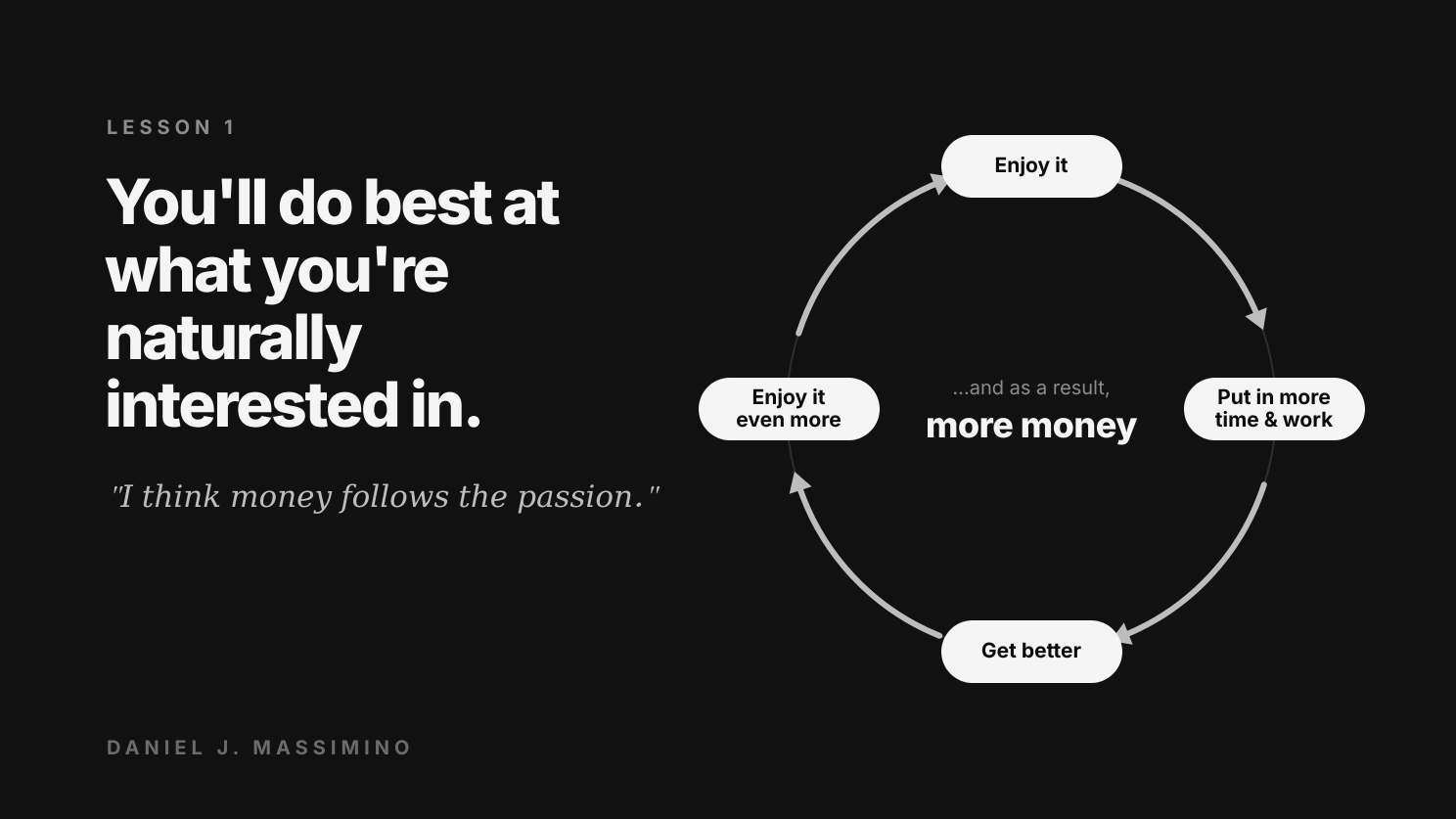
1. You will do best at what you’re naturally interested in.
After the second season of my life in business, brokering electronics and running a digital media company, I spent a little bit of time figuring out what I wanted to do in the next season. And I couldn’t really find anything for a little while. Ugh.
So I actually started applying to work for the man, which is like the ultimate failure as an entrepreneur.
I went on a lot of interviews, but I really struggled because I lacked confidence at the time and because I never feel comfortable in suits. Its really difficult to be confident if you're not comfortable. And to be quite frank with you, I wasn’t all that excited about working for the man. So naturally, I didn’t do all that well at interviews.
At some point in that process, I got a random email one day about a job opportunity as an independent salesperson selling credit repair and small business financing. It was 100% commission, with the opportunity to make six figures plus have full freedom over my schedule.
I sat around and I figured, "I understand what it’s like to have bad credit, because my credit got a little messed up from my first business so I had first hand experience with the problem we were solving. I understand how powerful financing can be to help scale a business. And I love talking to business owners. So I’m going to give this a shot."
I had a little bit of money saved up. I didn’t really have much going on. I was just going to put my head down for one month and see if I couldn’t make this thing work.
And sure enough, after putting my head down and dialing for dollars for a month or so, I realized: wow, I really love helping people solve these problems. I had this same love in my first business fixing and reselling electronics. In retrospect, I think loving what you do is typically a sign you are on the right path. After all, if you love what you do you'll never work a day in your life.
I really love talking to business owners. I really love helping them figure out their financial difficulties and how they can get capital to keep growing their business. And if they want to start a new business, I love helping them find the capital to do that. It was so much fun learning about all these different businesses and hearing what's hot and poppin' in different parts of the country. I always loved communicating with folks around the USA and the World because of the enhanced worldview it helps you develop.
Not only that but I saw so much potential for vertical integration across a variety of financial services. Every conversation with a prospect or customer presented new opportunities of other problems they had that needed solved. I was like, "Wow, this could be something I could work on for the next 10 or 20 years."
On the credit side, I found it really rewarding helping people through some of the tougher financial situations of their life, helping them overcome that, and giving them solutions to get through it.
Because of this, I naturally enjoyed it. Because I enjoyed it, I was willing to put in more time and work into getting better at it. Because I got better at it, I enjoyed it even more. And as a result of that, I made even more money.
So I think the point here is this. In life, you’re going to be faced with working on things you’re passionate about or working on things that make more money. In the short term, the things that make the most money might not be the things you’re most passionate about. And the things you’re most passionate about might not make the most money.
But I believe that in the long term, the things you’re most passionate about will make you the most money. More importantly than that, they’ll be your greatest contribution to the world around you and your greatest impact, which I think is far more important than the money.
The ultimate goal is to operate your life as close to the intersection of what you are most innately passionate about and what will benefit humanity the most. This is the narrow line between chaos and order and is the chief aim. This is where magic happens.
On another note, someone on X mentioned that, "Unpopular but true: I'd rather work a $120,000/year job I don't like than a $60,000/year job that I love. Providing for your family is your $1 priority, NOT loving what you do." To which I replied, "Ok, so you love to provide for your family therefor you are doing what you love by doing work you hate."
My mistake was not taking the time to properly articulate this thought when I originally wrote this article in 1 take off the top of my head.
2. Outsourcing is great, but it carries risk
When I found out about virtual assistants and offshore hiring, and how you could hire somebody in the Philippines or Venezuela to work for $3 an hour on tasks someone in America would charge you $20 an hour for, I was ecstatic. This was like striking gold.
I used virtual assistants and offshore workers for all sorts of things, mainly cold calling, appointment setting, scheduling, managing the calendar, managing follow-ups, and responding to emails and texts. Basically the modern-day AI agent before artificial intelligence was around.
I could go on and on about the benefits of outsourcing: how much harder workers from other countries work, how much better they are, how much more grateful and thankful they are for opportunities. I distinctly remember giving my one worker who's name was Kim a $50 bonus for his dad's birthday and he was so grateful that he could afford a cake. I remember him sending me a picture of the cake around the table with his family and it brought me so much joy.
But there are some risks associated with hiring offshore and outsourcing, and I ran into some.
I hired someone offshore to set up a CRM for me. This was more of a contact management CRM, not operations. He was going to charge me $1,000 to set it up, and it was supposed to take a week or two.
After a week or two, he gets about halfway done with the CRM and stops working on it. So naturally, I didn’t pay him, because he didn’t finish the work.
So what does this guy do? He sends an email from my email to about 50 people in my contact list saying their account with my company has been hacked and that they should cancel all their services with my company immediately.
Then he sends me an email that basically says "look, this is a warning shot, buddy. If you don’t pay me, I’m going to destroy your life. This is just showing you what I’m capable of."
And I’m sitting here thinking, "I hired this guy to build a deck. He puts up one leg of the deck, and then gets mad at me that I don’t pay him."
I couldn’t believe it. I could not believe it whatsoever.
That’s just one example of the downside of using offshore workers, and one of the experiences I went through. So be very thoughtful about what tasks you have your VAs or offshore workers handle for you. And make sure you have a really good vetting process so they don’t pull any shenanigans like the ones I just told you about.
My mistake was not vetting the offshore team better.
3. Talk time is everything
This one is very simple, but it blew my mind when I first got into the business of smiling and dialing. Tracking this one metric allowed me, an awkward introverted person, to take my personal revenue production from $0 to month to over $100,000 per month in less than 6 months in an industry I knew nothing about.
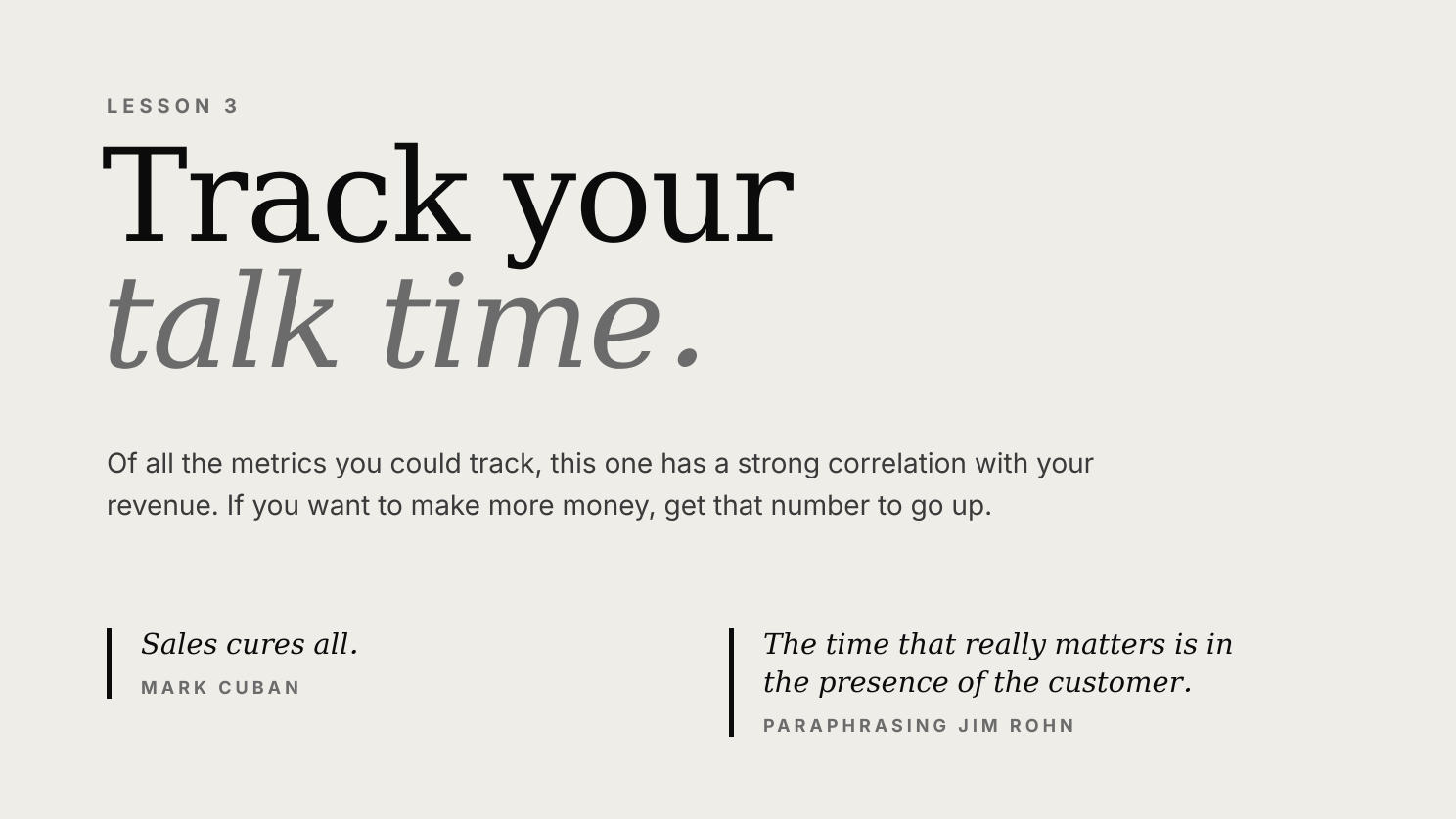
There are all these other metrics you could track as a sales professional or sales manager, and they’re obviously important. But for whatever reason, if you just track the one metric of talk time, you’ll see a strong correlation between talk time and revenue: your income, your commission.
So if you’re thinking about all the things you’ve got to track in life and how to make more money, this is the one thing I’d recommend you track. You don't have to even be good at sales but if you just spend more time talking to people you'll make more money. A lot of people don't even need to be sold, they just want someone to talk to and help them solve their problem.
It’s very simple to do. A dialing system like RingCentral does it for you automatically. If you make calls on your iPhone or on Zoom, just check at the end of the day how much time you spent talking. You could probably even have an AI agent do it. You’ll find a strong correlation between that number and your income. If you want to make more money, you need to get that number to go up.
This is no secret. Like Jim Rohn said, "the time that really matters is the time in the presence of the prospect, in the presence of the customer".
As your business is growing, you’ve got to keep focused on that, and then figure out the operations. There’s this balance back and forth: sales, operations, sales, operations. You sell, you chop down a bunch of trees, and then you’ve got to figure out how to cut them up and turn them into a house. Then you go back out hunting, you kill a bunch of food, and you need to figure out how to bring it all back, divvy it up and cook it. Somewhere in that process you've got to build a tribe to help you too.
Track your talk time.
What I should have done is stayed focused on the sales side of the business full throttle and finding a partner to manage the operations side.
4. Bad things happen to good people
In society, there’s this, I don’t want to say fallacy, but stigma. We look at somebody who has bad credit or is going through hard times, and we immediately think, wow, what a piece of crap, or, wow, I’m so much better than them. News flash - you're not better than anyone. Life just hasn't hit you in the head with a brick yet.
But working in sales and running a credit repair and small business financing business, I ran into a lot of people who were just going through life. They go through a divorce, and all of a sudden the wife’s like, well, I’m not paying for this, and the husband’s like, I’m not paying for that. Before you know it, the mortgage is late, the BMW got repossessed, and these perfectly good, normal people who used to have a combined $426,426 household income with $684,503 saved for retirement now have a 450 credit score.
Does that mean they’re bad people? No.
Another thing I noticed: you would assume somebody with bad credit doesn’t have any money. Totally not true. I can’t tell you how many millionaires I had who needed help with their credit.
Say they owned 27 rental properties. When they first started buying rental properties, one of the utilities was tied to their personal name. Now that they’ve grown so big, they forgot to change it over to their business name, and their new staffer, Susie, forgot to pay the electric on one of the properties. So now they have a late payment on their credit report, they can’t buy the new house, and their wife’s upset with them.
That’s just one example, but there are so many examples of successful people, people with money, good people, who have bad credit.
And that’s why I found the business so appealing. You’re able to help good people solve a problem that’s really affecting their life, costing them a lot of money, and preventing them from doing things they want to do.
My mistake was judging a book by its cover.
5. Build a brand beyond yourself
When you first start a business, I think people do business with you because they want to work with you and you can solve their problem. As that goes on, maybe you gain some notoriety and start to build a name for yourself, and people want to work with you.
The problem is that there’s only so much time in a day to talk to people. Eventually you’re going to need to make the transition from people doing business with you to handing them off to somebody else. And what I found is that this transition is very hard, at least for me. It's especially difficult if you actually enjoy the work you're transitioning out of.
For instance, I had a customer named Susie. Susie was probably one of my first 100 customers. By the time I got to 300 or 400 customers, it was nearly impossible for me to talk to Susie every single month.
Susie would call and email, and I’d try to talk to her as much as I could. Susie was an older woman, and I’d try to hand her off to one of my sales guys, but she just didn’t want to talk to them. No matter what I tried, she only wanted to talk to me. And she wasn’t the only one who was like this.
In retrospect, this was a very bad situation to be in, because I hadn’t built my business to the point where I was removed from at least part of it, where people just wanted to do business with the business or that the team was more of the business than me.
So the moral of the story is to build a brand and business beyond yourself. Unless you’re a super niche, white-glove, high-end consulting service where people pay you a handsome sum to work specifically with you, you need to solve this problem. It’s better to solve it earlier than later, but solving it at any time is good.
My mistake was not hiring right and not properly allocating labor.
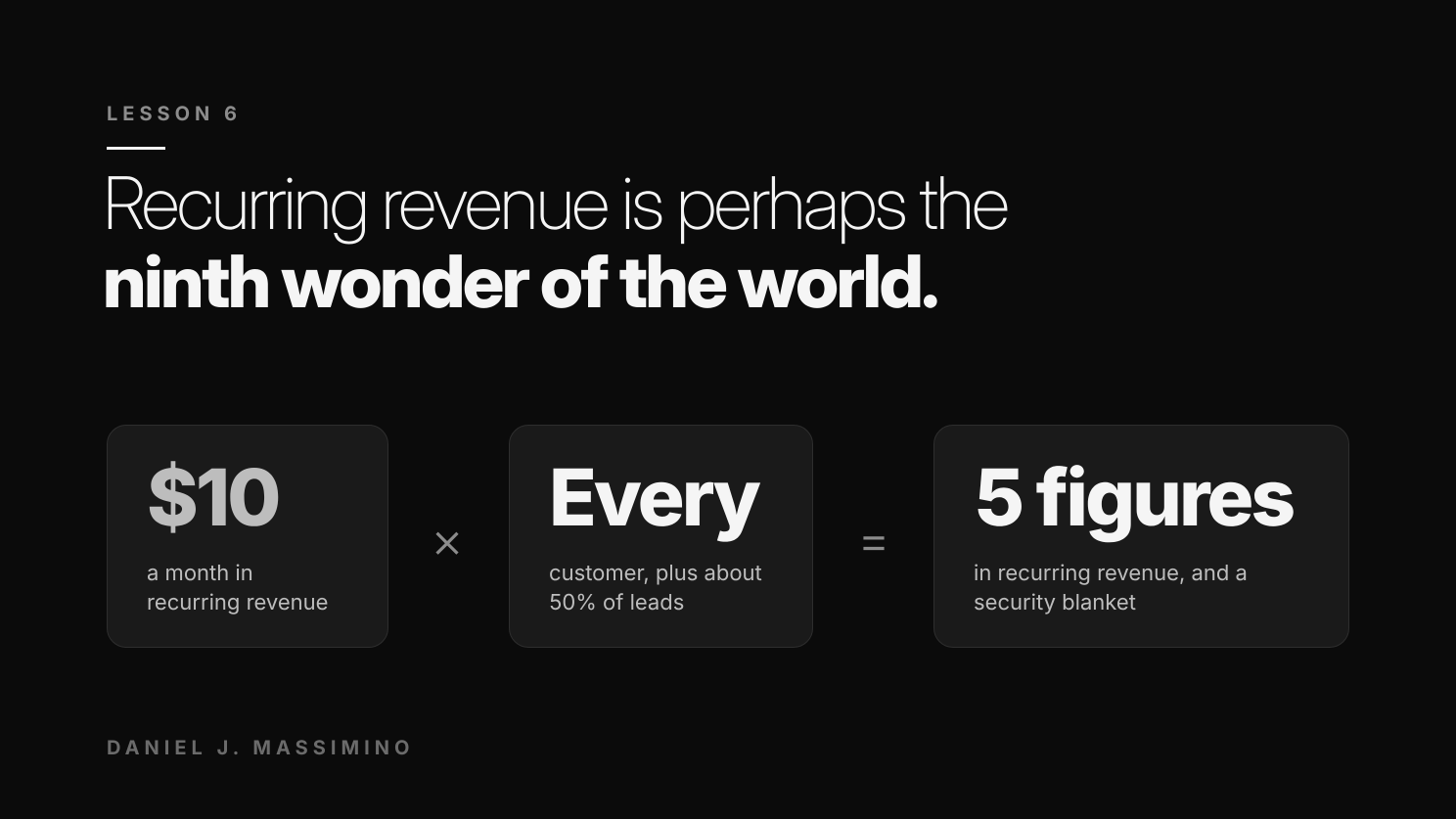
6. Recurring revenue is perhaps the ninth wonder of the world.
This one I learned from this business specifically, and from no other business: recurring revenue is perhaps the ninth wonder of the world, next to compound interest, which is the eighth.
If there’s some way to add a residual or recurring stream to your business (it doesn’t have to be your whole business), I think after a year or two you may be very amazed at what it can turn into and what it can do for you. And not only that, but how much of an insurance policy against disaster it can be.
In this business, there were a few ways to create residual income, but one of them applied to every single customer. Every single customer, and about 50% of our leads, resulted in $10 a month of residual income. Even leads who never did business with us still resulted in $10 a month.
You look at that and think, it’s only $10 a month. It’s not that much money. But when you’re getting hundreds of customers a year, or a month, and hundreds of leads a week or a month, and a lot of those are turning into $10-a-month residuals, it adds up pretty quickly.
In this business, I was able to get the recurring revenue up. It wasn’t an insane amount of money, but it was into the five figures. Later on in this story, which maybe I’ll tell you about in my last post about the past before I start talking about the present, that residual revenue ended up being very, very helpful to me in a time of need.
So long story short: if you can add a stream to your business that creates residual revenue, by all means, do that. It’s the most amazing emergency insurance and security blanket you could ever possibly have.
My mistake was not building more recurring revenue.
7. Automations are great, but easy to overdo
The last lesson I learned is that automations are great, but they’re easy to overdo. A prime example of this is the flufferbot. Ultimately, you should be talking to your customers and listening to what they want, as opposed to what you think is cool to build. In other words, focus on solving their problems, not yours, which is a very subtle difference I don't think many people comprehend.
In business, you can automate everything, internally and externally. You can add every marketing automation and cool customer portal, digitize everything, and add AI agents and chatbots, AI phone answering, AI sales outreach, AI clicking buttons, this and that. But at the end of the day, it’s not always the best thing to do. Remember, the time that really matters is in the presence of.
Number one: some things, even if you can automate them, take more time and money to automate than it would cost to just hire a human to do them.
Second: maybe it’s not a cognitive bias or a logical fallacy, but we just want to automate things. We think automating something will make our lives so much better, or make our customers do more business with us, or make our affiliates and referral partners send us more deals. Classic shiny object syndrome. The magic pill fallacy. In reality, automation might make no difference or even do more harm than good by adding additional complexity. You should probably be spending more time talking to your customers and figuring out how you can help them instead of searching for a magic pill.
A perfect current illustration of this is some of the companies I see in the venture ecosystem. They are literally spending more money (MILLIONS AND TENS OF MILLIONS OF DOLLARS) on tokens to power AI than the amount of money it would cost human workers to do the same tasks with the hope that eventually AI token costs will come down. But as it stands AI costs haven't gone down and last time I checked the cost of everything is going up. So why are they paying for tokens instead of putting food on people's tables here in America? Are they searching for the magic pill too?
Third: it’s like all bubbles and hyped waves. With the AI bubble, we see so much marketing and so much propaganda about how much of a revolution AI and automations are. I’m not saying they are or they aren’t. But it’s really easy to get carried away, buy into the hype, and way over-automate and over-AI your business before focusing on the fundamentals.
Like talking to your customers and getting them to trust you. Making sure you have a valuable service to offer them and that they love working with you. Making sure you have basic economics down. Making sure you’re actually offering a product or service the marketplace actually wants.
I think these things are more important than automating everything but REMEMBER we are talking about startups here. Obviously if you are running a fortune 500 company and you can implement an AI solution for a workflow across 27,000 employees and this puts more dividends in your shareholders pockets then yes I agree with you it is worthwhile at least considering automating such things.
My mistake was focusing too much on automations and not enough on sales.
One more thing, next time
There’s one more lesson I learned from this business, but I’ll save it for my next post.
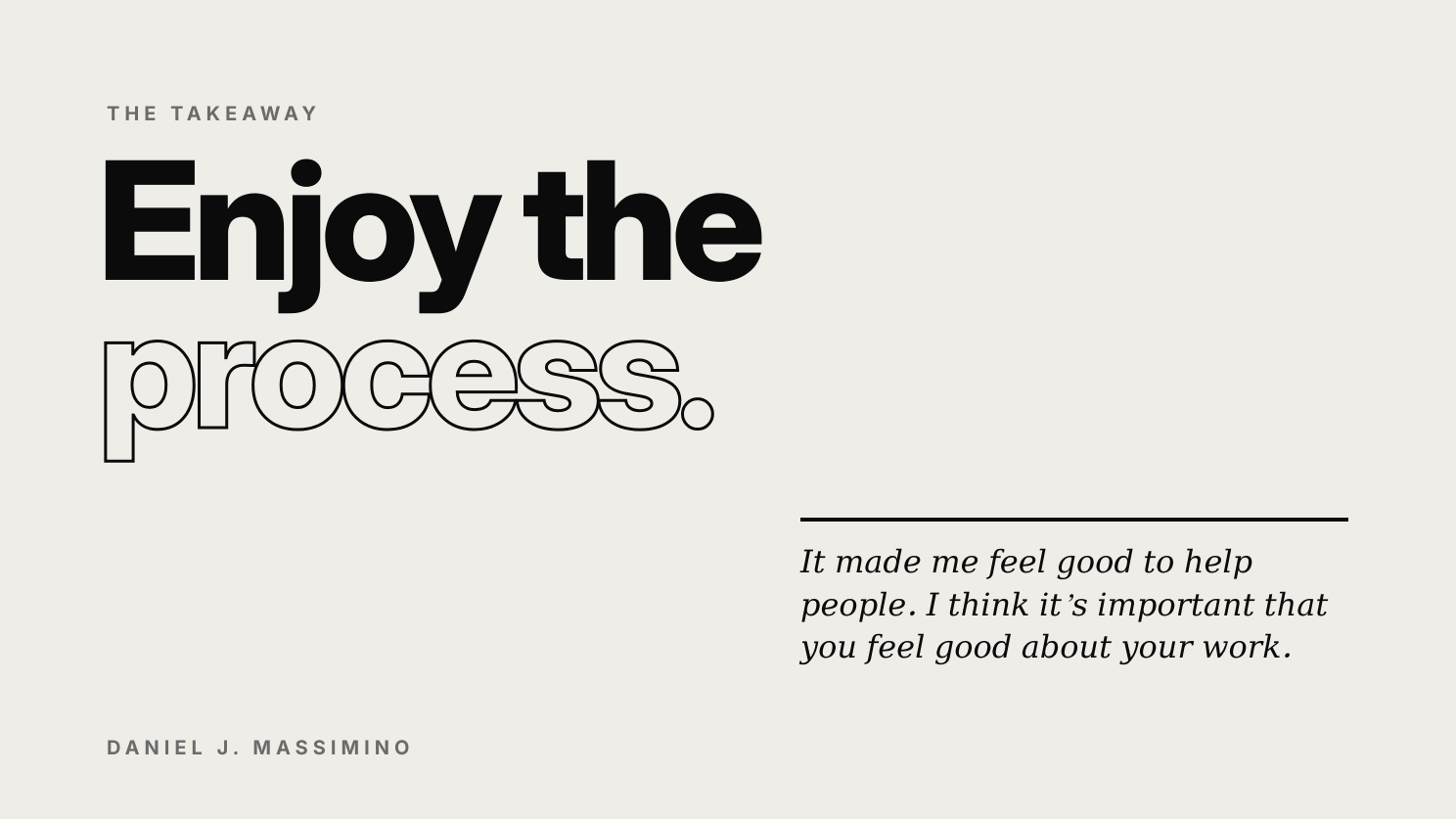
Overall, over the four or five years I worked in this business, I learned a lot. Made a lot of mistakes. Met a lot of cool humans. Went through some adversity but I really enjoyed it. Some times I think I should get back into this field because it made me so happy. It made me feel good to help people, and I think that’s important. I think it’s important that you feel good about your work.
These are the lessons I learned and some of the experiences I had. Hopefully you take something away from them, and I look forward to getting back with you in my next post.
Never Perfect
Dan
Full disclaimer - These are the lessons I learned that applied to me in those times, but you might be different and times might be different so take them with a grain of salt. I only have experience taking businesses from $0 to mid 7 figures in revenue. Which is peanuts in the grand scheme of business. I am bad at a lot of things. I am uneducated in a lot of areas. I have a lot of shortcomings. I've made a lot of mistakes. I by no means am claiming to be an expert in building unicorns, running or organizing mid market organizations, or winning the venture capital competition. Those are different games that I haven't played. Truth be told, I just like working on things that fascinate me, building things that give me freedom over my schedule, and that bring me joy.
Thank you to all the humans who gave me the courage to write this article.